As the second part of our blog series on the NCS system, today we take a look on what school subjects are and how they changed from OBE to all the way to CAPS
366 views
TD
Tau de tau
NCS System - CAPS Definition of Subjects
The National Curriculum Statement NCS policy was introduced to mirror South Africa's democratic aspirations in education post 1994 into concrete goals, transitioning away from the heavily segregated apartheid education system and subsequent complex Outcomes-Based Education (OBE) frameworks that respectively, explicitly and tacitly towards a more structured, national, and inclusive development tool.
discriminated disadvantaged communities
Apart from aiming to redress social issues from past transgressions in an educational context, the NCS was also formulated to modernize the country's public subject offerings in line with standards of other countries.
CAPS Definition of Subjects
The Education Information Standards defines:-
Subject: A specific body of academic knowledge selected and organized as part of a curriculum.
Curriculum: A statement of intended outcomes to be achieved, what knowledge content is to be acquired, which competencies and skills are to be developed, and the levels of performance that are expected from learners in each of the grades.
The CAPS framework in aid to the NCS, sets out individual 48+ subject documents as recommended by the 2008 Maintaining Standards Report, which assessed the impact of adoption of the NCS system from the archaic heavily fragmented Outcome-Based Education OBE system. The subject guidelines that resulted from this recommendation encompassteaching, clarity of assessment tasks & assessment tools, which are all unique for every subject, though a learner can only take a maximum of 7 subjects for the National Senior Certificate (NSC).
Furthermore, of the subjects on offer, learners are offered a 4compulsory subjects; Home language, First Additional language, Mathematics or Mathematical Literacy and Life Orientation. The remaining 3 subjects are elective from a broad number of subjects of Science stream, Commercial/Economic stream or Technical/Engineering stream.
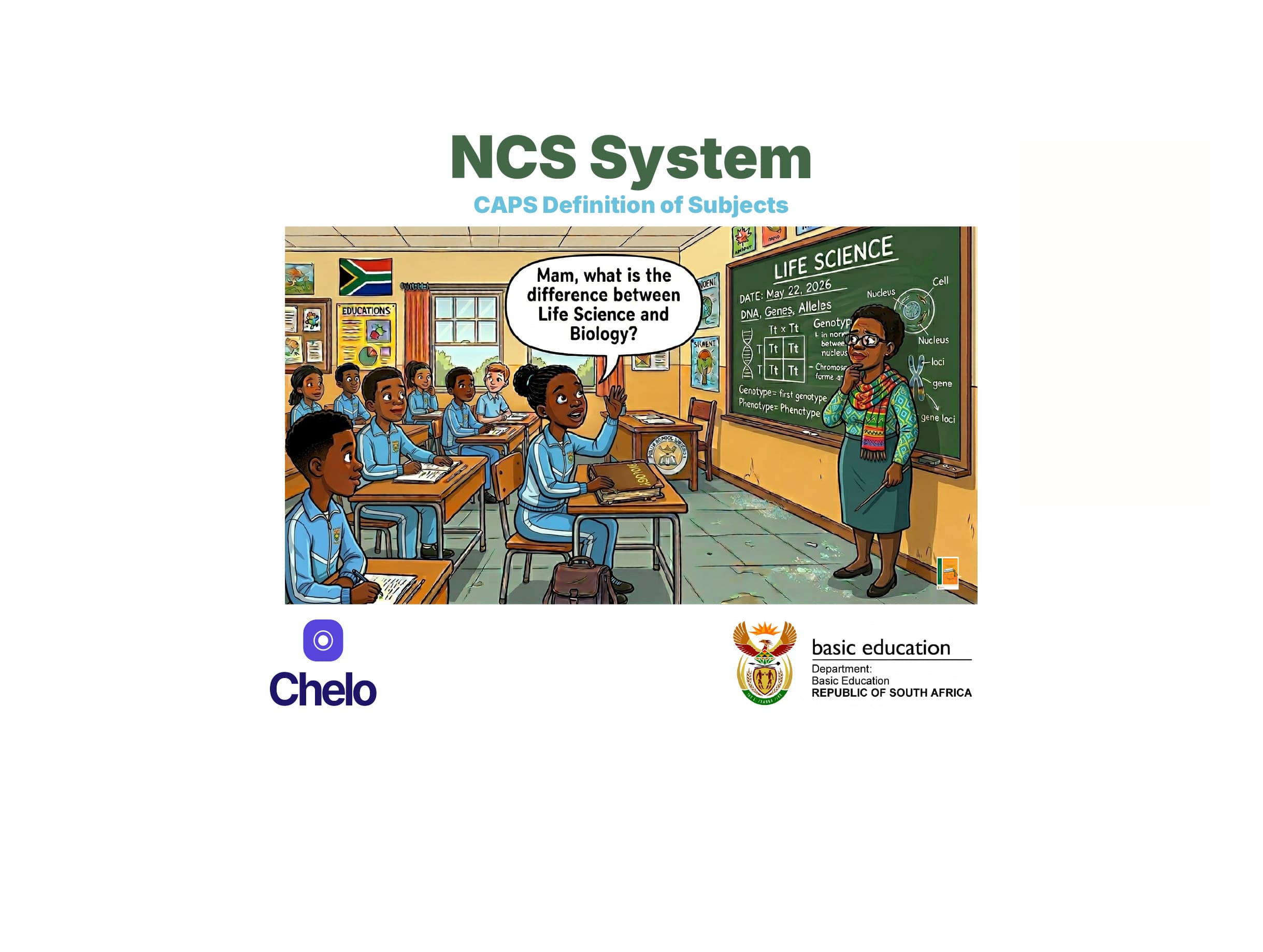
Difference between Life Science and Biology?
Life Science is a broader subject that is an extension of biology, adding genetics, technology and environmental systems to the core scientific study of living organisms and their vital processes, that biology covers.
Chelo's Take
The NCS system is an extensive highly abstract document supported by the CAPS amendments and other legislation that have since aimed to make the curriculum changes that were necessary post 1994, more practicable. However, big challenges still exist in how teachers and learners have approached current subjects in accordance with the prescribed practices and norms recommended in the CAPS amendments.
What's Next
The team at Chelo has been dedicated to assessing and solving the key causes that have resulted in underwhelming results of learners at schools. Through constant dialogues with teachers, principals, and learners we believe a multi-faceted approach is necessary, not only in monetary and non-monetary ways, but also in terms of government, business, and members of society all contributing towards all children in South Africa having an equal quality education. At Chelo we work towards that reality.
Join Us!
Whether you’re an alumnus, a donor, a teacher, or simply someone who believes in education — you belong in the Chelo community