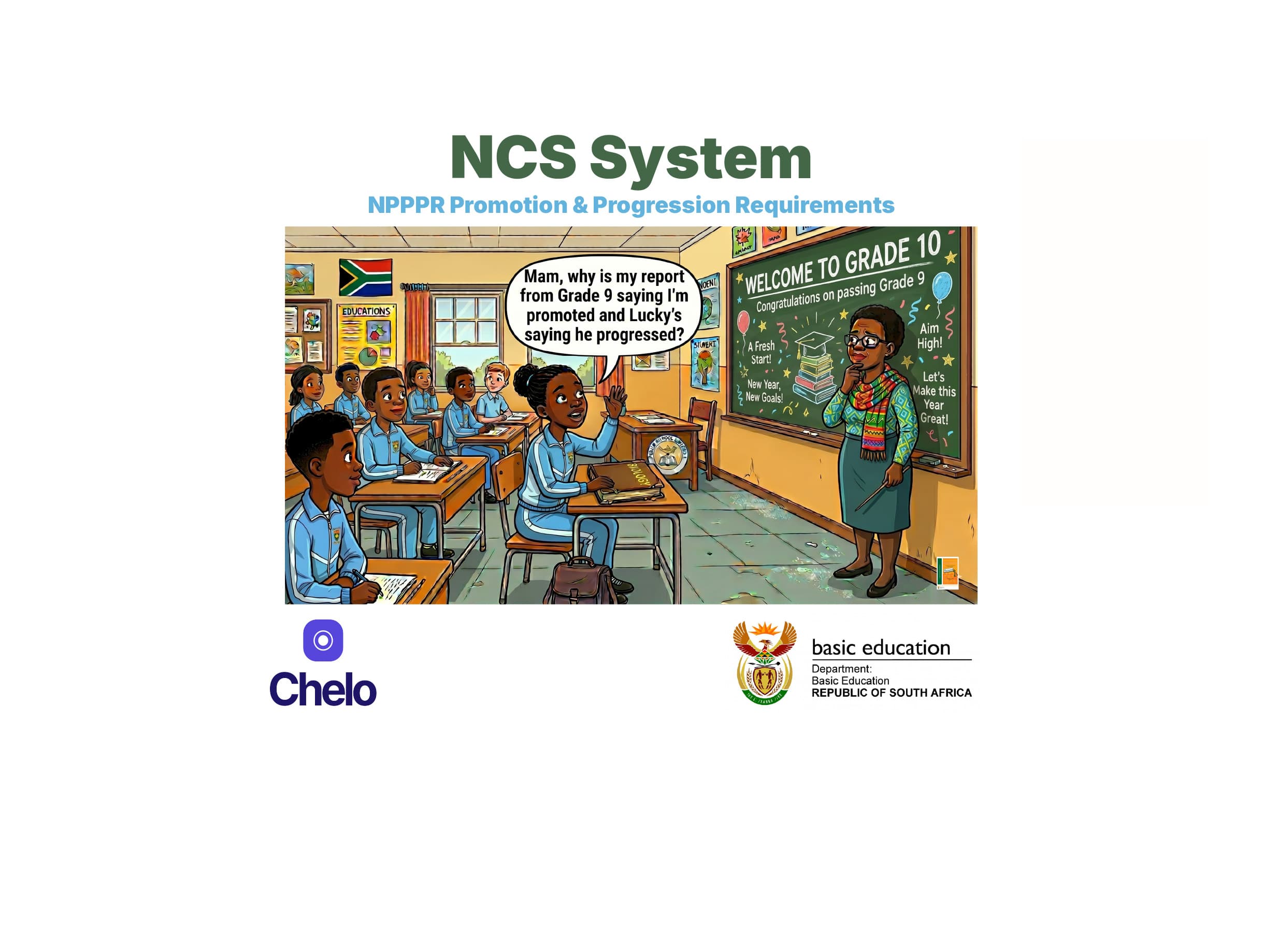
NCS System - NPPPR Promotion & Progression Requirements
As the third part of our blog series on the NCS system, today we take a look on what the promotion & progression requirements are and the difference between the two according to the NPPR.
401 views
TD
Tau de tau
NCS System - NPPPR Promotion & Progression Requirements
Together with the Curriculum and Assessment Policy Statement(CAPS), the NPPPR aids learners education journey using two processes: promotion and progression. While these terms are often used interchangeably, they do not mean the same thing.
What is Promotion?
Promotion is the standard academic advancement of a learner from one grade to the next. It occurs when a learner successfully meets the minimum required level of achievement across their subjects for that specific grade. To be promoted, a student has effectively "passed" the grade by complying with the standard promotion requirements of the CAPS curriculum.
Promotion Requirements in the Foundation Phase (Grades 1–3)
In the Foundation Phase, learners are assessed continuously through classroom activities and formal tasks. Promotion is based on whether the learner demonstrates sufficient competence in literacy, numeracy, and life skills. Teachers monitor development carefully because these years build foundational learning skills.
Promotion Requirements in the Intermediate and Senior Phases (Grades 4–9)
From Grade 4 onward, learners receive percentage-based results and achievement levels with the minimum requirement to be declared as having passed a subject being 30%. Consequentially obtaining a percentage below the minimum requirement is categorized as "not achieved".
For the intermediate phase (Grade 4-6), a minimum of 6 subjects can be taken for the year, but In order for a learner to be promoted from a grade, learners must passat least 5 of their enrolled subjects.
In contrast, the senior phase (Grade 7-9), a minimum of 9 subjects can be taken, with the minimum promotion requirements being that learners must pass 8 of their enrolled subjects.
Promotion Requirements in the FET Phase (Grades 10–12)
In the Further Education and Training phase (Grade 10-12), promotion becomes more structured to prepare learners for the National Senior Certificate (NSC), with formal assessment tasks contributing more significantly in learner advancement decisions. Learners are required to enroll a minimum of 7 subjects, needing to pass at least 6 subjects.
What is Progression?
Progression is the advancement of a learner to the next grade despite the learner not having met all the minimum promotion requirements.
The Department of Basic Education uses progression to prevent a learner from being retained in a single educational phase for a period exceeding 4 years. The core principle is that it is often more detrimental to a learner's social and psychological development to remain significantly behind their age cohort.
However, progression is not a free pass. When a learner is progressed, the NPPR mandates that their underperformance must be addressed. The school is required to provide tailored academic support and interventions in the new grade to help close the learning gaps.
Chelo's take
Understanding this difference is crucial when evaluating the operational realities of a school. A high number of progressed learners requires significantly more resources and targeted interventions. Current DBE databases do not distinguish between learners in schools, how many have been promoted or progressed.
This has resulted in a facade, with schools appearing as if they have adequate resources for a quality education, especially in the learners per teacher ratio. In reality, teachers often struggle to give learners individual attention which causes dereliction of those deemed to be slow. Furthermore, funds are then misused to address problems wrongly thought to be causing learner failures, clutching at straws.
What's Next?!
At Chelo we aim to work hand in hand with the Department of education to refine the efficacy of their systems where possible and to ensure no learner is left behind. Recognizing the resource gap created by learner progression is a vital step towards ensuring our initiatives make lasting impacts in the education of all learners.
Join Us!
Whether you’re an alumnus, a donor, a teacher, or simply someone who believes in education — you belong in the Chelo community